Guardianship vs Supported Decision-Making for Autistic Adults
When your autistic child approaches 18, a series of legal changes happens whether you are ready or not. At midnight on their birthday, they become their own legal decision maker. Medical providers, schools, banks, and government agencies shift to treating them as an adult. For some parents, this is straightforward. For others, especially those whose child has significant support needs, it raises urgent questions about how to continue helping.
For decades, guardianship was the default answer. Today, families have more options, and many are moving away from full guardianship toward less restrictive alternatives. Understanding the full range of choices helps you pick what actually fits your adult child, not what is simply the most familiar path.
Why This Matters
At 18, an autistic adult, regardless of support needs, has the legal right to make their own decisions about medical care, education, finances, living situation, and relationships. Providers cannot share information with parents without permission. Schools cannot discuss progress with you. Medical decisions belong to your adult child, not to you.
For many autistic adults, this is appropriate and desired. For others, unsupported independent decision-making is not realistic for every domain of life. The question is how to provide the support they need without stripping away more rights than necessary.
The spectrum of options, from most restrictive to least, includes guardianship, limited guardianship, supported decision-making, power of attorney, and simply providing informal help. Each has its place. The right fit depends on the individual.
Full Guardianship
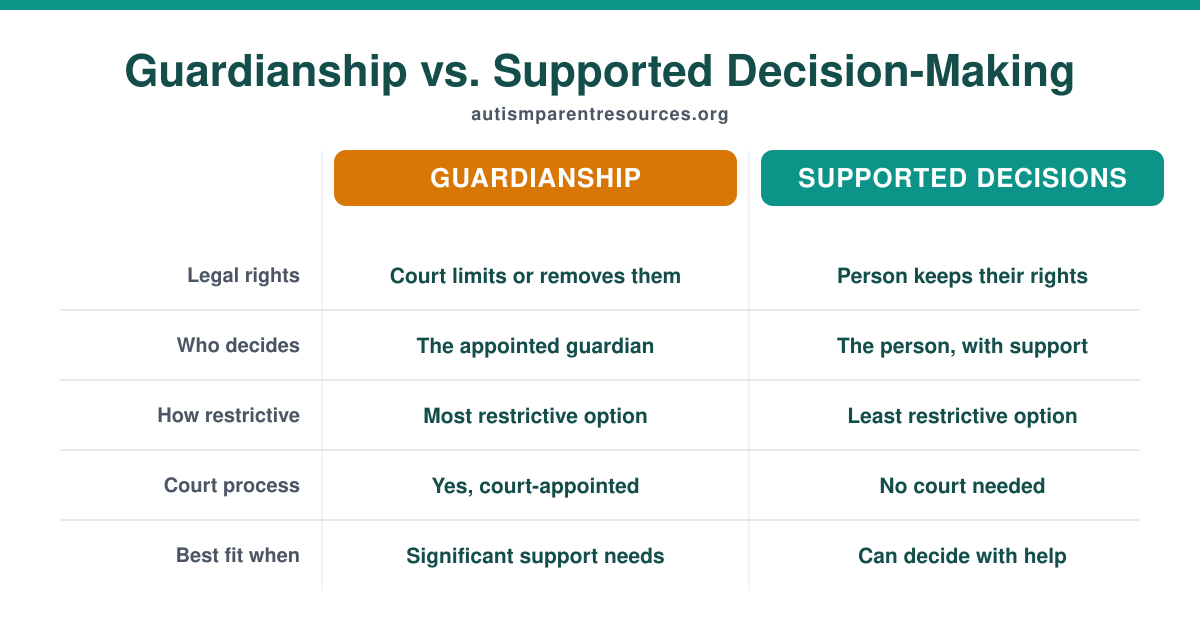
Full guardianship, sometimes called plenary guardianship or conservatorship, is the most restrictive option. A court grants one person, the guardian, the legal authority to make decisions for another person, the ward. The ward loses most of their legal rights: the right to vote in some states, to marry, to sign contracts, to make medical decisions, to manage finances, and more.
Guardianship is traditionally used for individuals who cannot make or communicate any decisions about their own welfare. For autistic adults with very significant support needs, full guardianship may still be the right tool.
The downsides are serious. The autistic person loses legal autonomy over their own life. Courts are involved in major decisions. Annual reports are often required. The process is public. Restoring rights later, if the person grows in capacity, is possible but not automatic and requires additional court action.
Many disability rights advocates argue that full guardianship has been over-used historically, applied to people who could have made decisions with support rather than through a substitute decision maker. The trend across the country is toward less restrictive options wherever possible.
Limited Guardianship
Limited guardianship is a middle ground. The guardian has authority in specific, court-defined areas, while the ward retains rights in all other areas. For example, a limited guardianship might cover medical and financial decisions while the ward keeps the right to make decisions about where to live, who to date, and whether to vote.
This is often a better fit for autistic adults than full guardianship. Many individuals have strong capacity in some domains and need support in others. A limited guardianship preserves autonomy where the person can exercise it and provides support only where it is genuinely needed.
The specifics vary significantly by state. Some states offer clear frameworks for limited guardianship. Others default to full guardianship unless parents specifically request limits. Working with an attorney who knows your state's specific options matters.
Supported Decision-Making
Supported decision-making is a newer framework, increasingly recognized in state laws across the country. Rather than replacing the disabled person's decisions, supported decision-making formalizes the role of trusted supporters who help the person understand options, think through decisions, and communicate their choices.
In supported decision-making, the autistic person remains the legal decision maker. Their supporters, named in a formal agreement, can attend appointments, help translate complex information, assist with paperwork, and be present during difficult conversations. But the decision itself belongs to the person.
This approach honors the principle that most people, including most with disabilities, can make their own decisions when given appropriate support. It also recognizes that even neurotypical adults lean on trusted people for major decisions, and that the disabled person's network of support can be formalized legally without substituting judgment.
Supported decision-making works well for autistic adults who can communicate their preferences and make choices when given information in accessible forms, even if they need help understanding complex situations or managing logistics. It does not work for individuals who cannot communicate preferences at all, where substitute decision-making may be necessary.
As of 2026, more than 20 states have enacted supported decision-making legislation. Check your state's current status and specific provisions. Even where formal laws do not yet exist, supported decision-making can often be implemented through power of attorney and advance directives.
Power of Attorney and Advance Directives
A power of attorney is a document in which an adult gives another person authority to make decisions on their behalf in specific areas. Durable power of attorney continues even if the person later becomes unable to communicate. A health care power of attorney covers medical decisions. A financial power of attorney covers financial matters.
Unlike guardianship, a power of attorney is created by the person themselves, not imposed by a court. It preserves the person's legal autonomy while giving designated helpers the authority to act when needed.
Many autistic adults can execute a power of attorney. The person needs to understand what they are signing and express the intent to grant authority. For individuals who meet that threshold, power of attorney is often a far better option than guardianship.
An advance directive, sometimes combined with a health care power of attorney, lets the person specify their wishes for medical care. A HIPAA release authorizes sharing of medical information with designated people. All of these tools, used together, can often provide the support a family wants without going to court.
Choosing Among the Options
Start by asking what specific situations worry you. Making medical appointments? Understanding insurance? Managing money? Signing a lease? Each specific concern often has a specific tool that addresses it without requiring full guardianship.
Assess your adult child's capacities honestly. What can they do with support? What genuinely cannot be done with any level of support? The answers may surprise you. Many autistic adults whose parents assumed needed guardianship turn out to thrive with supported decision-making.
Involve the autistic person in the conversation if at all possible. Even adults with significant support needs often have preferences about their own lives that should guide planning. Participation in choosing one's own support structure is itself meaningful autonomy.
Consider starting less restrictive and adding protection if needed. Moving from supported decision-making to guardianship later is easier than restoring rights once taken. Errors on the side of autonomy are usually better than errors on the side of restriction.
Working With an Attorney
An attorney who specializes in special needs planning or disability law can help you evaluate the options and draft appropriate documents. Not every attorney is current on the less restrictive alternatives. Ask specifically whether they have experience with supported decision-making and limited guardianship in your state.
The cost varies. Power of attorney documents may cost a few hundred to a few thousand dollars. Guardianship involves court filings, evaluations, and ongoing reporting, which can add up significantly. Supported decision-making agreements, if available in your state, are often relatively simple and affordable.
Transition Planning Starts Early
The legal transition happens at 18, but the preparation for it should start several years earlier. Starting around age 14, transition planning is built into IEPs by law, and decision-making capacity is one area to assess and develop.
Work with your child during the teen years on the specific skills they need: understanding medical appointments, managing money at their level, signing their own forms, advocating for themselves in meetings. These skills develop over time with practice, and the age-18 transition goes much more smoothly when they have been cultivated deliberately.
Talk openly with your child, in age-appropriate ways, about what will change at 18 and what the options are. Their input into the plan is both meaningful and practically useful.
A Common Path for Autism Families
Many families of autistic adults end up using a combination of supported decision-making, power of attorney, and HIPAA releases. Guardianship, when used at all, is often limited rather than full. This approach preserves rights, respects autonomy, and still provides real support where needed.
Some families discover their adult child needs less structure than they expected. Others find the reverse. Either way, starting with less restrictive options and adding structure only where genuinely needed is usually the right approach.
The Bigger Question
At the heart of this decision is a question about respect. Do we treat our adult disabled children as fully human, with the right to direct their own lives as much as they are able, while providing support for what they cannot do alone? Or do we default to control because it feels safer?
The disability community, including many autistic self-advocates, has pushed hard in recent decades for approaches that center autonomy. The research supports their case. Adults with more control over their own lives have better outcomes in mental health, physical health, and overall quality of life.
Your adult child's life is theirs. Supporting them in living it, as independently as they are able, is the goal. The legal structure you choose should serve that goal, not subordinate it to adult convenience.