Meltdowns vs Tantrums: Understanding the Difference in Autism
From across the room, or to a stranger at the grocery store, they look the same. A child on the floor. Screaming, crying, perhaps kicking or flailing. Red face. Inconsolable. But to the people who know the child well, and to the child themselves, meltdowns and tantrums are entirely different experiences. Understanding the difference is one of the most important shifts parents of autistic children can make.
The Core Difference
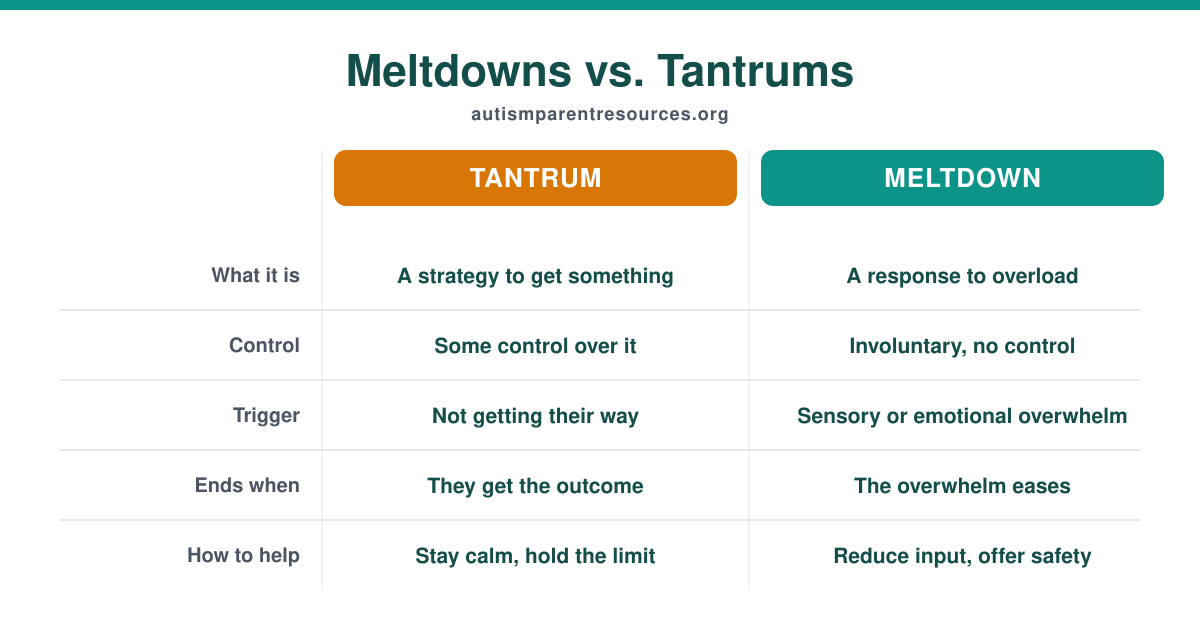
A tantrum is goal-directed behavior. A child wants something, cannot have it, and escalates in an attempt to get their way. The tantrum is aimed at an outcome. If the outcome changes, the tantrum often ends.
A meltdown is not goal-directed. It is a neurological overload response. The nervous system has exceeded its capacity, and the resulting reaction is involuntary. The child is not trying to get anything. They are overwhelmed beyond their ability to cope, and their system is in crisis.
This is not a minor semantic distinction. It changes everything about how to understand and respond to what is happening.
What a Tantrum Looks Like
A tantrum typically has a clear trigger: something the child wants that they cannot have. The toy at the checkout counter. The cookie before dinner. The turn that went to a sibling.
During a tantrum, the child is aware of their environment. They may glance at the parent to gauge their reaction. They often pause briefly when ignored and resume when attention returns. They may quiet down quickly if they get what they want.
Tantrums are more common in younger children and decrease as emotional regulation develops. They are developmentally normal and appear in essentially all children to some degree.
What a Meltdown Looks Like
A meltdown may have a trigger, but often it is the accumulation of many small stressors that finally overwhelm the system. The final incident that triggered the meltdown may seem small or even absent. The real cause was the ten things before it.
During a meltdown, the child is not meaningfully aware of their surroundings. They are not calculating. They are not monitoring the parent. They often are not even fully present in the moment. What looks like defiance or manipulation is actually a nervous system that has lost its ability to self-regulate.
Meltdowns do not respond to giving the child what they want. They do not stop when ignored. They run a course that has to complete itself, like a storm that has to blow through.
After a meltdown, many children are physically exhausted, sometimes disoriented, and often sad or ashamed. They may sleep. They may be hypersensitive for hours afterward. This is called the recovery phase, and it is real.
Why the Difference Matters
If you treat a meltdown like a tantrum, you will do everything wrong. Ignoring a meltdown, using time-outs, trying to reason with a child, or attempting discipline all worsen the situation. You are applying pressure to a nervous system that has already broken down.
If you treat a tantrum like a meltdown, you may accidentally reinforce behavior you did not mean to encourage. Though in practice, this is far less harmful than the reverse error.
Many parents of autistic children have been told for years that their child is having tantrums, when what they are actually witnessing are meltdowns. Family, school staff, and sometimes even professionals misidentify the behavior. The result is a child who is repeatedly punished for something they cannot control, which damages the parent-child relationship and worsens the underlying regulation issue.
Identifying Triggers
Meltdowns have triggers, even when the trigger is not obvious. Common autism-related triggers include sensory overload from sound, light, crowds, or certain environments; cumulative masking fatigue after a school day or social event; changes in routine or unexpected events; hunger, thirst, or interoception issues; transitions between activities; social confusion or misunderstanding; and physical discomfort like pain, illness, or needing the bathroom.
Keep a log. Write down what happened before, during, and after each meltdown. Patterns usually emerge within a few weeks. Some families discover their child melts down consistently after school, suggesting masking fatigue. Others find that certain stores, certain relatives, or certain activities reliably produce meltdowns.
Knowing the triggers lets you prevent meltdowns before they happen, which is almost always better than managing them after.
Preventing Meltdowns
Prevention is the most powerful intervention. Reduce the demands on an already-stretched nervous system.
Preserve a decompression window after school. No questions, no demands, no surprises for 30 to 60 minutes. Snack, quiet activity, preferred show, time alone if that is what they need.
Use visual schedules and advance warnings for transitions and changes. A child who knows what is coming can prepare. A child surprised by change often cannot manage.
Watch for early warning signs. Most children show signals before a meltdown: pacing, quieter, more rigid, repetitive phrases, subtle stimming increases, irritability. Catch these signs and reduce demands immediately.
Build sensory breaks into the day. Short periods of preferred sensory input, like deep pressure, movement, or quiet, can prevent the cumulative build-up that leads to meltdowns.
Keep food and hydration steady. A hungry, thirsty, or exhausted nervous system is much closer to overload. Regular snacks and water can prevent regulation failures.
Responding to a Meltdown in Progress
When a meltdown is happening, your job is to minimize harm and support recovery. Not to teach. Not to discipline. Not to process. Those all come later.
Ensure safety. Move the child away from hazards. Remove others who may be hurt. Get to a safer environment if possible.
Reduce stimulation. Dim lights. Quiet voices. Fewer people. Less talking from you. A calm, quiet, low-demand environment supports the nervous system to come back online.
Offer presence without demands. Stay close if the child wants you close. Give space if they want space. Some children want physical contact during meltdowns, others cannot tolerate it. Learn your child.
Do not try to talk it out, reason, or make the child explain. The parts of the brain that handle language and reasoning are offline. Asking what is wrong is asking for something they cannot produce.
Use as few words as possible, delivered in a calm, quiet tone. If anything, state neutral facts. "You are safe. I am here."
Be patient with recovery. Even after the obvious meltdown ends, the nervous system is still recovering. Continued quiet, low demands, and comfort support full recovery. Pushing too quickly to return to normal can trigger a second wave.
What to Avoid
Do not issue ultimatums, bargains, or threats during a meltdown. These are language-based and cognitive, both of which are unavailable.
Do not try to teach in the moment. "If you calm down, we can talk about it" is a phrase that may work for tantrums but does nothing for meltdowns.
Do not take it personally. Your child is not trying to hurt you. They are not manipulating you. They are drowning. Their behavior is not aimed at you, even if you happen to be in the line of fire.
Do not punish after the fact for behaviors during a meltdown. A child who has already been overwhelmed beyond their capacity is not served by consequences applied to behaviors they did not control. Consequences suggest the child chose their behavior. They did not.
Do not discuss it in detail immediately after. Recovery needs quiet. Analyzing what happened, offering corrections, or planning for next time can come hours or days later, not in the moments after.
The Conversation After
Some time after the meltdown, often the next day or later, a calm conversation can be helpful. Not to assign blame, but to understand and plan.
With younger children, keep it simple. "Yesterday was really hard. I wonder if the noise at the store was too much. Next time we could try X."
With older children, you can be more reflective. "I know you were really overwhelmed yesterday. What do you think led up to it? Is there anything we could do differently next time?"
The goal is collaborative problem-solving, not interrogation. The child is not the problem. The accumulation of stressors is the problem, and you are working together to prevent the next one.
Supporting the Child Long-Term
Over time, children can develop more awareness of their own triggers and early warning signs. This is a skill, like any other, that grows with practice and age.
Help them build a toolbox of regulation strategies. Deep breathing, sensory tools, movement, quiet time, preferred activities, and trusted people to go to. Each child's toolbox is unique.
Validate that meltdowns are not their fault. Children who grow up believing they are bad because they have meltdowns carry shame for years. Children who understand that meltdowns are neurological events, not moral failures, approach them with self-compassion that supports real growth.
Treat meltdowns as information, not as battles. Each one tells you something about what overwhelmed your child. Over time, the patterns inform how you structure their world.
When to Seek Additional Support
If meltdowns are frequent, intense, or causing safety concerns, additional professional support is warranted. An occupational therapist with sensory expertise can help identify and address sensory triggers. A mental health professional who understands autism can work on regulation skills. A developmental pediatrician or psychiatrist can assess whether co-occurring conditions like anxiety, ADHD, or depression are adding to the burden.
For severe or dangerous meltdowns, especially in older children or teens, a more comprehensive evaluation may be needed.
The Bigger Shift
When parents understand the difference between meltdowns and tantrums, a lot of things change. The frequency of discipline decreases. The focus on prevention increases. The relationship becomes less adversarial. The child starts to experience their parents as safe during hard moments, not as additional stressors.
This shift does not happen overnight. You will still have hard moments, wrong reactions, and days when you feel like you cannot do this. Give yourself grace. You are learning as your child grows.
The child at the floor of the grocery store is your child. They are not trying to embarrass you. They are not manipulating you. They are in trouble, and they need you, not on your best parenting performance, but as their steady presence through the storm.
You can be that. It takes work, and you can do it.