ABLE Accounts for Autism Families: What They Are and How to Use Them
Saving money for your autistic child is complicated if they may one day rely on needs-based benefits like Supplemental Security Income or Medicaid. Those programs have strict asset limits. A well-meaning grandparent who leaves a grandchild $20,000 can accidentally make that child ineligible for essential supports. For decades, this was one of the hardest problems in disability financial planning. ABLE accounts changed that.
What an ABLE Account Is
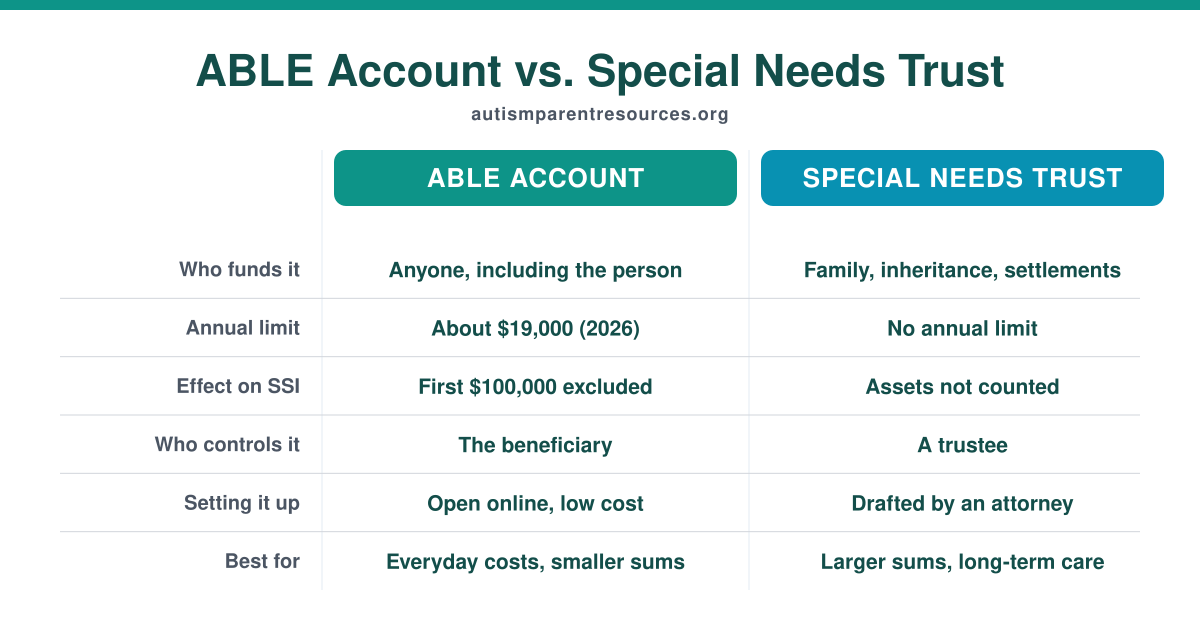
ABLE stands for Achieving a Better Life Experience. ABLE accounts are tax-advantaged savings accounts specifically designed for people with disabilities. Money in an ABLE account generally does not count against the $2,000 asset limit for SSI and many other means-tested programs. The first $100,000 in an ABLE account is fully disregarded for SSI purposes.
The account is owned by the person with the disability, though it can be managed by a parent, guardian, or other authorized individual. Money can be used for a wide range of qualified disability expenses, and earnings in the account grow tax-free if used for those purposes.
The Achieving a Better Life Experience Act passed in 2014, and the first ABLE accounts opened in 2016. Since then, the program has expanded significantly, making it one of the most important tools in modern disability financial planning.
Who Qualifies
To open an ABLE account, the beneficiary must have a qualifying disability that began before a certain age. As of 2026, the age of disability onset has been raised to 46, meaning anyone whose disability began before their 46th birthday can qualify. This is a significant expansion from the original age 26 limit.
Qualifying means the person either receives SSI or SSDI for their disability, or has a disability certification from a licensed physician confirming the person meets Social Security's definition of disability. For autism, a formal autism diagnosis from a qualified provider typically meets the requirement.
Only one ABLE account per person is allowed.
What You Can Use the Money For
ABLE funds can be used for "qualified disability expenses," which is defined broadly. Covered expenses include education, housing, transportation, employment training, assistive technology, personal support services, health care, prevention and wellness, financial management, legal fees, funeral and burial expenses, and basic living expenses.
In practical terms, this covers most things a family might spend on behalf of a disabled person. Therapy copays, specialized equipment, transportation to medical appointments, tutoring, summer programs for the disabled child, housing modifications, and even general living costs can all qualify.
Housing expenses are a special case. Using ABLE funds to pay housing costs in the same month they are taken out of the account is generally fine. Housing expenses paid from funds that sat in the account and then were withdrawn in a different month can be scrutinized for SSI recipients. Keeping clean records matters.
Contribution Limits
The annual contribution limit equals the federal gift tax exclusion, which adjusts most years. As of 2026, the basic limit is $19,000 per year from all sources combined.
If the beneficiary is working and does not contribute to a retirement plan through their employer, they can add additional earned income contributions above the basic limit, up to the federal poverty level for a one-person household. This provision, called ABLE to Work, helps disabled workers save more for their future.
The total account balance can grow to a state-specific limit, typically $300,000 to $500,000 or more. Above $100,000, any amount over that threshold does count against SSI asset limits, though other means-tested program rules vary.
Who Can Contribute
Anyone can contribute to an ABLE account: the beneficiary, parents, grandparents, other family, friends, or even the beneficiary's own earnings. This makes ABLE accounts an excellent option for grandparents and relatives who want to give money to a disabled grandchild without causing benefits problems. The gifts count against the donor's annual gift tax exclusion but are otherwise straightforward.
For families planning larger inheritances, an ABLE account alone is not enough. A special needs trust may be appropriate for larger transfers. ABLE and special needs trusts are complementary tools, each suited to different amounts and uses.
Opening an Account
ABLE accounts are administered at the state level. Each state runs its own program, and most programs accept enrollees from any state, not just their own residents. This means you can shop around for the program that best fits your needs.
To compare programs, look at fees, investment options, minimum contribution requirements, debit card availability, and state tax benefits if your state offers them for ABLE contributions. The ABLE National Resource Center, a project of the National Disability Institute, provides comparison tools and plain-language guides.
Opening an account typically takes about 15 to 20 minutes online. You will need the beneficiary's identifying information, proof of disability, and a bank account to fund the initial deposit. If the beneficiary is a minor, a parent or guardian serves as the authorized person.
How ABLE Interacts With Other Benefits
For SSI, the first $100,000 in an ABLE account is completely disregarded. Above $100,000, the excess counts as a resource, and SSI payments may be suspended until the balance drops below $100,000. SSI is not terminated during suspension, only paused. Medicaid continues during SSI suspension.
For Medicaid, ABLE funds are disregarded without the $100,000 cap in most states. This means families can save significantly more in ABLE for future needs while still maintaining Medicaid eligibility.
SNAP, housing subsidies, and other federal means-tested programs generally follow similar disregard rules for ABLE accounts, though specifics vary.
A caution worth knowing: on the beneficiary's death, any funds remaining in the ABLE account may be subject to Medicaid repayment for services received during the beneficiary's lifetime. This is called Medicaid payback. Some states have waived or limited this, but it is a real consideration. A special needs trust can avoid this issue, which is one reason many families use both vehicles together.
Practical Uses Over Time
In early childhood, ABLE accounts are often used to save for therapy copays, educational supports, and equipment that insurance does not cover. Contributions can be modest but consistent.
In adolescence, the account may fund transition-related expenses, specialized camps, assistive technology for school, and eventually costs related to post-high-school options.
In adulthood, ABLE accounts often fund housing expenses, transportation, employment supports, and quality-of-life costs that SSI alone cannot cover. Having dedicated savings separate from the basic benefit makes a meaningful difference in standard of living.
Over a lifetime, an ABLE account managed well can grow substantially, providing flexibility and security that neither SSI nor savings in the parent's name could offer.
What ABLE Does Not Replace
ABLE accounts are powerful but limited. For families with significant assets, larger inheritances, or complex estate planning needs, a special needs trust remains essential. An ABLE account paired with a trust handles different tiers of assets and different types of uses.
ABLE accounts also do not replace the need for basic financial planning for parents: life insurance, retirement savings, and estate documents. Your own financial security supports your child's future, too.
Getting Good Advice
Because the intersection of benefits, taxes, and planning is complex, consider consulting a financial planner or special needs attorney who works with disability families. Not every advisor understands these tools well. Ask specifically about their experience with ABLE accounts and special needs planning.
The ABLE National Resource Center offers free educational resources that are an excellent starting point. Many state ABLE programs also offer free webinars and customer support.
A Tool Worth Using
If your child has autism, opening an ABLE account is one of the most impactful financial steps you can take for them, often in a single afternoon. The benefits compound over years, and the protections it provides can preserve access to essential programs throughout your child's life.
Whether you can contribute $10 a month or $10,000 a year, the account is worth opening. Your future self, and your future adult child, will thank you.