Social Security Benefits for Autistic Adults: SSI and SSDI Explained
Social Security offers two disability programs that many autistic adults rely on for income and access to health coverage. SSI and SSDI sound similar and are sometimes confused, but they work differently, have different eligibility rules, and serve different groups. Understanding both helps families plan and advocate effectively as their child approaches adulthood.
The Two Programs in Plain Terms
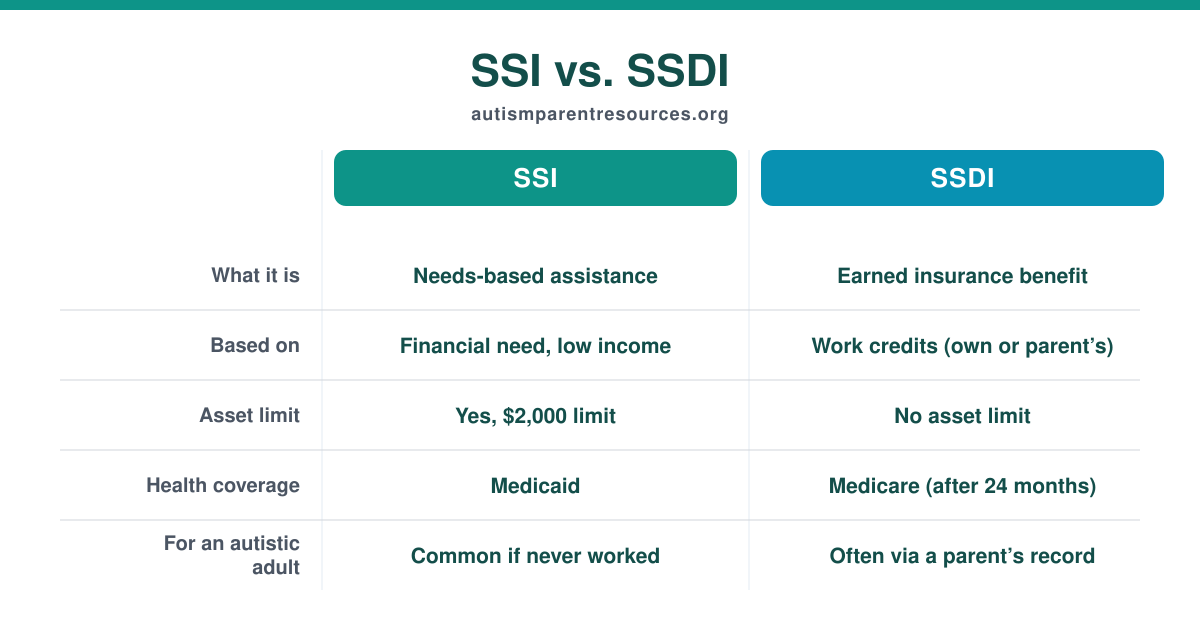
Supplemental Security Income, or SSI, is a needs-based program for people with disabilities and limited income and resources. It is funded by general tax revenue. Monthly payments in 2026 max out at a federal benefit rate that adjusts annually, with some states adding supplemental amounts. SSI recipients generally qualify automatically for Medicaid in most states.
Social Security Disability Insurance, or SSDI, is an insurance program funded by payroll taxes. To qualify, a person must have a sufficient work history with Social Security taxes paid, or must qualify as a Disabled Adult Child based on a parent's work history. SSDI payments can be higher than SSI and come with access to Medicare after 24 months.
These programs can be combined, and some recipients receive both. An autistic adult with a work history but low earnings may qualify for SSDI while also receiving supplemental SSI.
SSI Eligibility
To qualify for SSI, a person must have a qualifying disability, limited income, and limited resources. For adults, the disability must prevent substantial gainful activity, which is defined each year by Social Security. In 2026, the SGA threshold is approximately $1,620 per month for non-blind individuals.
Resources, meaning assets other than the primary home, one vehicle, and personal belongings, are limited to $2,000 for an individual. This asset limit has not changed in decades, despite inflation, and is one reason ABLE accounts and special needs trusts are so important for autism families.
Income rules for SSI are complex. Earned income reduces the SSI payment, but only after certain exclusions. Unearned income, like gifts, reduces the payment more heavily. The income rules are designed to encourage work but can feel punitive without careful planning.
For a child under 18 applying for SSI, parental income and resources are counted through a process called deeming. This is why many families with modest incomes find their disabled child does not qualify for SSI in childhood but may qualify at 18, when parental resources no longer count.
SSDI for Autistic Adults
SSDI has two possible paths for autistic adults. The first is through their own work history. To qualify, a person generally needs 40 work credits, with 20 earned in the last 10 years. Younger workers have lower thresholds. Each year, a worker can earn up to four credits. For many autistic adults, especially those who have worked part-time or inconsistently, meeting the work history requirement is possible but not automatic.
The second path, and the more common one for autism families, is the Disabled Adult Child benefit, sometimes called Childhood Disability Benefits. A person who became disabled before age 22 can qualify based on a parent's work history when the parent retires, becomes disabled, or dies. This is an important benefit worth understanding.
The DAC benefit requires that the adult child have a continuous disability that began before age 22, has not engaged in substantial gainful activity, and has a parent who is receiving Social Security retirement or disability benefits, or who has died with sufficient work credits. If the qualifying parent is still working and not receiving benefits, the adult child's DAC benefits do not start until the parent begins collecting.
DAC benefits can be meaningful. They are based on the parent's earnings record, so for children of workers who earned good wages, the monthly payment can be substantially higher than SSI. DAC also unlocks Medicare eligibility for the adult child after 24 months.
The Application Process
Applying for SSI or SSDI is a significant process. The initial application can be completed online, by phone, or in person at a Social Security office. For applicants with autism, careful preparation dramatically improves the odds of approval on the first try.
Gather documentation early. You will need the person's identifying information, school records, medical and psychological evaluations going back to childhood, details of current functioning, work history if any, and statements from treating providers. Social Security wants to see a longitudinal picture, not just current symptoms.
Medical evidence is everything. The autism diagnosis alone is not enough. Social Security needs evidence that the condition meets their specific standards, which focus on functional limitations. A recent evaluation from a qualified provider that specifically addresses the Social Security listing for autism, or that documents functional limitations in cognitive, social, adaptive, and executive domains, is enormously valuable.
Be honest and detailed in describing the applicant's struggles. Social Security is evaluating inability to work and inability to function independently at adult-level expectations. Minimizing difficulties, even if done out of pride, hurts the application. The form is not the place to emphasize strengths. It is the place to document what support is needed and what cannot be done.
Denials and Appeals
A majority of initial disability applications are denied. Autism applications are not exempt from this. Do not take a denial as final.
The appeals process has multiple levels: reconsideration, hearing before an administrative law judge, appeals council, and federal court. Most approvals happen at the hearing level, often a year or more after the initial application. Persistence matters.
Many families work with a disability attorney or advocate for the appeals process. Attorney fees are capped by law and are paid only out of awarded back benefits, so there is typically no upfront cost. A good disability attorney can significantly improve the odds of success.
Gather additional documentation during the appeals process. New medical evidence, updated evaluations, and detailed statements from people who know the applicant's daily functioning can all strengthen the case.
Age 18 Redetermination
A child receiving SSI must be re-evaluated at age 18 under adult disability standards. This is called the age 18 redetermination, and it is a critical moment. The rules for adults are stricter than for children, and a surprising number of young adults who received SSI as children are denied continuing benefits at 18.
Prepare for the redetermination well in advance. An updated evaluation specifically focused on adult functioning, including work-related limitations, is often essential. Document the specific ways the person cannot function at an adult level of work, social interaction, self-care, and independent living. This is not the place to be optimistic about potential.
Continuing benefits at 18 has long-term implications. Many adult services and supports are tied to benefit eligibility. If benefits end at 18 because of an inadequate redetermination, restoring them later can be difficult.
Working While Receiving Benefits
Both SSI and SSDI allow some work without full loss of benefits, though the rules differ.
For SSI, earned income reduces the monthly payment, but through a formula that preserves much of the work incentive. The first $65 of earnings, plus half of earnings above that, is excluded. This means working does pay, though the calculations require attention.
For SSDI, a Trial Work Period allows nine months of work at any earnings level without affecting benefits. After that, an Extended Period of Eligibility gives 36 months during which benefits continue in any month earnings fall below SGA. Work rules for SSDI are more all-or-nothing than for SSI.
The Ticket to Work program offers employment supports and services for people on SSI or SSDI who want to work. Using Ticket to Work can provide coaching, job placement, and protection against medical reviews while working.
Many autistic adults can work at some level without losing benefits. The fear of losing benefits sometimes holds people back from trying, but the rules are designed to allow exploration. A benefits counselor, available free through the Work Incentives Planning and Assistance program, can help model exactly how work will affect benefits in your specific situation.
Medicaid and Medicare
SSI recipients typically qualify automatically for Medicaid in most states. Medicaid covers medical care, long-term services and supports, and home and community-based services that can fund the care a disabled adult needs throughout life. For autism families, Medicaid is often the most important companion benefit to SSI.
SSDI recipients qualify for Medicare 24 months after beginning to receive benefits. Medicare covers medical care but generally does not cover the long-term services Medicaid provides. Individuals receiving both SSI and SSDI can have access to both Medicaid and Medicare, maximizing coverage.
Transitioning between programs, understanding spenddown rules, and managing dual eligibility are all topics worth learning as benefits begin. Your state's Medicaid agency and a benefits counselor can help you navigate the specifics.
Planning Ahead
If your autistic child will likely need SSI or SSDI, some early planning matters. Keep detailed records of evaluations, medical care, and school experiences that document the disability. Avoid situations that could complicate future applications, such as a large gift that puts assets above the $2,000 SSI limit.
Consider the timing of ABLE account contributions and special needs trust planning. Both interact with SSI eligibility in specific ways that a special needs attorney can clarify.
Start the application process before age 18 where possible. SSI applications can be filed beginning at the month the child turns 18, but gathering documentation and preparing the application takes time. Beginning the work at 17 avoids gaps in income as the young adult transitions.
The Bigger Picture
Social Security benefits are not a handout. They are a promise the country makes to support citizens who cannot support themselves through work because of genuine disability. For many autistic adults, these benefits are the foundation that makes the rest of their life possible, including housing, health care, and the ability to accept help that supports their quality of life.
Navigating the system is work. The rules are complex. The applications are demanding. Denials happen. But done carefully, with appropriate support, benefits can be secured, and they can last a lifetime. That lasting security is worth the effort it takes to obtain.